
Bigger Trees, Bigger Benefits
Throughout the world, big trees hold tremendous cultural, ecological, and economical value. While most of us can easily rattle off a list of the benefits of trees, the value of BIG trees has only recently been brought to light in scientific research and our understanding. According to the Center for Urban Forest Research, we know now that dollar for dollar, larger trees provide more economic benefits than their puny counterparts. Large-stature trees have more impact on conserving energy, reducing storm-water runoff, improving air, soil, and water quality, and increasing property values. Our sugar maple champion, for example, provides over $468 of these annual benefits and intercepts over 7,083 gallons of storm-water per year. In addition, our understanding of the role of big trees in a forest is also developing rapidly. Research in 2012 showed that big trees comprise less than 2% of the trees in any forest, but can contain 25% of the total biomass. Big, old trees lock up massive amounts of carbon, recycle soil nutrients, affect the water and climate within an ecosystem, supply abundant food and seeds, and provide critical habitat. Up to 30% of all vertebrates rely on large, old trees for cavities.
The Triumph of Big Trees
Recent research has also revealed two new surprising findings: Large trees grow more quickly! In a comprehensive study, scientists found that the largest trees gained the most mass each year in 97% of the species monitored. Another surprise involves carbon uptake (sequestration). It was previously believed that only young trees sequester carbon while growing and older trees simply store carbon. Now we know that the carbon uptake of trees continuously increases with their size because the overall leaf area increases as they grow! Perhaps the greatest contributions big trees have to offer is their superior genetics. As the mack daddies of the forest, they have survived the longest and lived through the weather extremes, land use changes, fragmentation of forests, population explosions, new pests and diseases, etc. And still they stand. Their seed and offspring are now more important than ever as our oldest, largest trees are rapidly declining in many ecosystems at all latitudes throughout the world.
This fall take the time to look up with new eyes as you walk through the autumn leaves. What are the stories of the trees near you? What historical events have they seen? Join Geauga SWCD as we celebrate and honor our biggest, oldest trees, and perhaps nominate one of your own in the future.
by: Gail Prunty, Geauga Soil and Water Conservation District
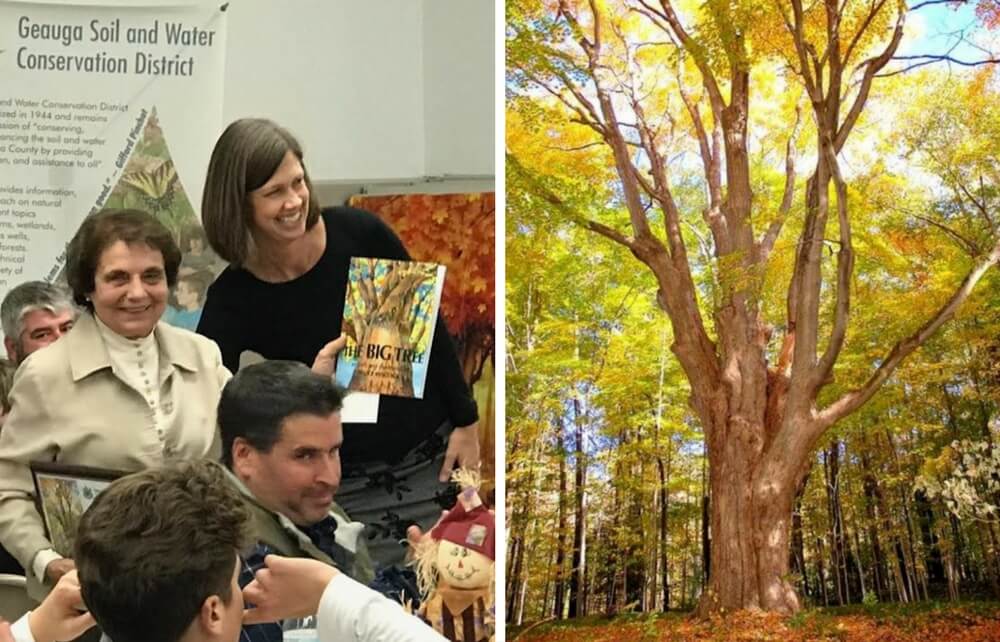
Pictured In Left Photo: Joan Demirjian of Bainbridge Township was recognized by Gail Prunty at Geauga SWCD’s Annual Meeting for nominating the champion sugar maple tree in the District’s 2016 BIG Tree Contest.
Pictured In Right Photo: Having a circumference of 174 inches, this sugar maple was nominated by Joan Demirjian of Bainbridge Township and won champion tree in Geauga SWCD’s 2016 BIG Tree Contest. (Photo by Karen Saari)
